
05 November 2021
Ebrahim Moosa | Palestine Information Network
The concluding days of Ramadan 1442 saw a vicious assault on musallees at Masjid al-Aqsa, with Israeli occupation forces making brazen armed incursions into the heart of the Masjid, shooting at worshippers, embarking on an arrest campaign and damaging Masjid property.
“Ramadan in Al-Quds is different” is a slogan Jerusalemites have popularised in recent years, expressing the longing Palestinians in al-Quds have for Ramadan, due to the beautiful flavour it brings to the city. Ramadan witnesses an influx in visitors to the Palestinian capital from across the West Bank and historic Palestine. There are awe-inspiring Taraweehs and Jummuahs, poignant duas, and picturesque family iftaars in the shade of the Dome of the Rock. The month also brings a much needed financial injection to the markets of Al-Quds, whose traders have for a long time borne the brunt of heavy Israeli taxation, their situation only exacerbated over the past year by crippling COVID-19 lockdowns.
Ramadan in al-Quds is different because it offers Jerusalemites a break from the stranglehold of Occupation, and the opportunity, for some moments, to have a taste of freedom.
Ever sure to sour the flavour, the Occupation began this Ramadan by placing metal barriers in the Bab al-Amoud area, thereby ruining a popular social rendezvous for Palestinians. When Palestinians resisted these restrictions, Israeli police responded with the language of violence, sparking pandemonium on the streets of Al-Quds. When they were ultimately forced to back down on the measures due to popular pressure, Israeli forces then shifted the arena of provocation to Masjid al-Aqsa itself.
On the final Friday of Ramadan, with an imposing crowd of 70 000 worshippers, many of whom had stayed on after a glorious Jummuah Salaah, the Occupation attacked the Masjid whilst Taraweeh Salaah was in progress. Chaotic scenes ensued as worshippers sought to dodge the volleys of tear gas, rubber coated metal bullets and sound bombs. Scores were injured and the Masjid was off bounds for hours. Most brazen were the attacks on a clinic at the Masjid as well as on journalists covering the events.
It was a scene to be repeated with yet greater intensity in the following days, when the Qibli Musallah, Dome of the Rock, and Bab ar-Rahmah at the Masjid were all besieged. Employing a similar arsenal, the Palestinian defenders of al-Aqsa on the receiving end experienced suffocation, and most of the injuries recorded involved shots to the head, eyes and chest. The Occupation prevented the evacuation of the injured, and there were impassioned pleas for help from the minarets of Al-Aqsa
Israeli forces sought to empty the area of Muslims to enable a settler incursion into the Masjid on the occasion of the Israeli Jerusalem Day. There was a spirited fight back from Palestinian murabiteen, and both the settler march and the police onslaught was forced to back-off.
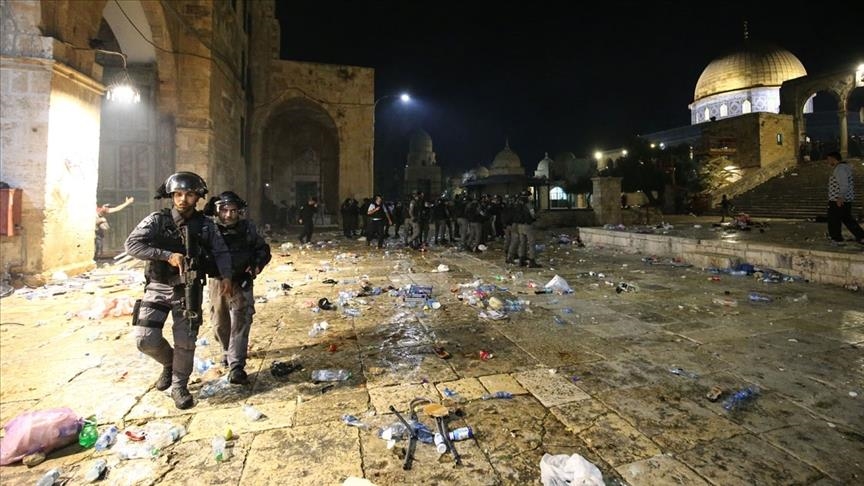
Images of the aftermath of the Israeli attacks underscore the gravity of the Occupation crimes committed this Ramadan. Munition shells littered the arena of the Mi’raj, windows were broken, and stones and debris covered the Masjid carpets. At one point, a large tree at Al-Aqsa even caught on fire sparking serious concern of damage to the Masjid.
The Zionist regime showed particular brazenness by mounting these attacks in the concluding days of Ramadan, and this too whilst Salaah was underway.
The scenes of an Aqsa literally on fire, and the haunting cries of Waa Islamaa and Ayna Salahudeen from the Masjid represented a major blight on the conscience of an Ummah that was unable to defend its third holiest site at an hour of peril.
The events presently gripping Al-Aqsa, Sheikh Jarrah and Bab al-Amoud are a fight for the heart and the soul of Palestine, and a litmus test for the Muslim World’s solidarity with the oppressed.
Who will rise to support the guardians of our first qiblah?
Follow updates from Masjid al-Aqsa on @firstqiblah on social media


